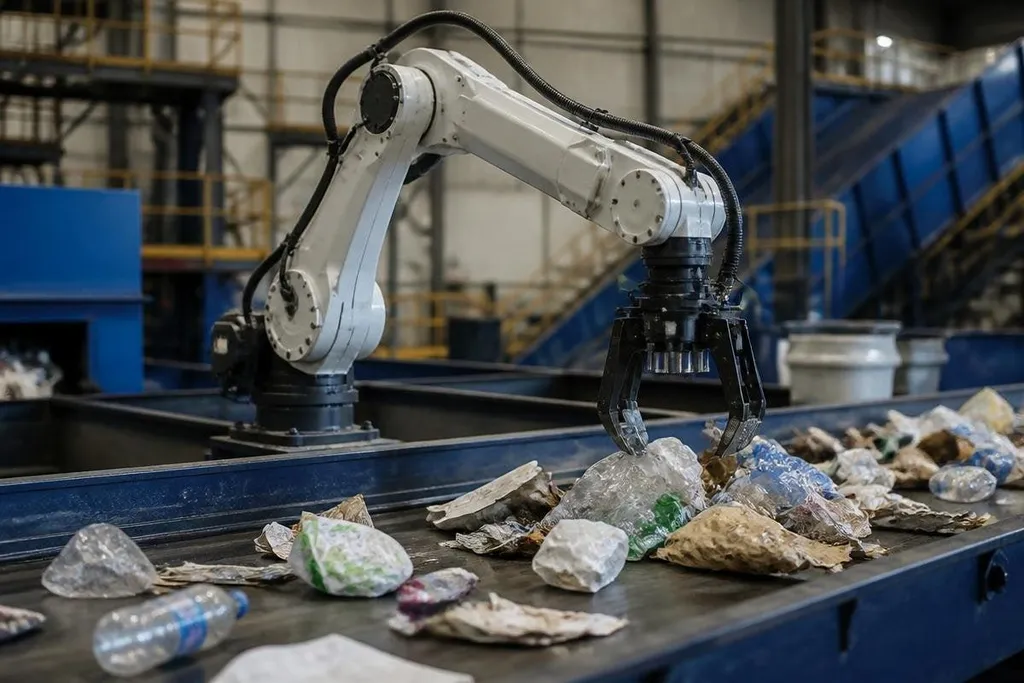
A waste-sorting robot can now use cameras, software, and a robotic gripper to identify items on a moving conveyor. The useful change is practical: the robot can adjust its choice as packaging, food waste, and damaged objects pass by instead of relying on one fixed rule.
- Cameras identify material: Computer vision reads an item’s shape, color, and surface.
- Software picks the action: The system chooses a gripper, air jet, or conveyor command.
- The hard limit: Dirty, hidden, or crushed items still cause mistakes.
How the robot sees waste
The process starts with computer vision, which means software that reads images from a camera.
An RGB camera records normal color, while a depth camera measures the distance to each object. Some systems may also use near-infrared sensors to help separate materials with similar colors.
That data gives the robot more than an item’s location. It can look for a bottle shape, a paper edge, a metal surface, or a food stain. The software then assigns a likely material type and sends a position to the robot arm.
The arm still needs time to act. A conveyor keeps moving, so the system must estimate where the item will be when the gripper reaches it. A small location error can send the arm to the wrong object, especially when items overlap.
What AI changes on the conveyor
Older sorting systems often depend on set rules. An object with a certain color or size goes to one bin. That method can work for clean, regular waste, but mixed waste creates harder cases.
An AI model can compare many visual clues at once. It may separate a clear plastic tray from a clear plastic bottle by shape, edge pattern, and position. It can also flag an item for a second pass when the image does not give enough evidence.
The response after identification depends on the robot hardware. A suction tool can pick up flat packaging. A two-finger gripper can hold a bottle or box. An air jet can push a light item into a nearby chute without stopping the belt.
These choices affect the plant’s layout and repair work. A robot that sorts well but needs a special gripper for each material may cost more to run than a slower system with fewer parts.
Waste sorting claims need a test with wet, crushed, or partly hidden items, not clean samples alone. Waste robotics reporting can connect the robot, sensor setup, line speed, and test date to the result before the system’s failures come into view.
Where the system still fails
AI does not remove the physical problems in a waste plant. Dust can cover a camera lens. Wet packaging can stick to the belt. A crushed carton may hide the label and shape that the model uses for its decision.
Training data creates another limit. If the model sees many clean bottles but few black trays, torn bags, or objects covered in food, its results may drop on those items. A plant needs images from its own waste stream, not only tidy examples collected in a lab.
The system also needs a way to handle uncertainty. Sending every doubtful item to a reject bin reduces sorting errors but lowers the amount of material recovered. Sending each doubtful item to a target bin raises the risk of contamination.
No general claim about AI can settle that trade. The useful measure is the plant’s own result: how much material reaches the right bin, how often the robot misses, and how much staff time repairs take.
What to check before a purchase
Use this checklist when you compare a waste-sorting robot with manual sorting or a rule-based machine:
- Name the waste stream: Test the exact mix of packaging, food residue, glass, paper, and metal found at your site.
- Check the sensor set: Ask whether the robot uses RGB, depth, near-infrared, or another sensor, and what each one can detect.
- Measure belt conditions: Record belt speed, item spacing, overlap, dust, moisture, and lighting during a normal shift.
- Set the error target: Decide how much contamination and how many missed items the plant can accept.
- Plan model updates: Confirm who adds new images, checks errors, and changes the model after the waste mix shifts.
- Price the full system: Include the arm, gripper, cameras, software, safety equipment, maintenance, and staff training.
I’d choose an AI sorting robot when the waste mix changes often and the plant can collect its own error data. A fixed-rule machine may be the better buy when the stream stays clean and predictable.
What happens next
The next useful step is a controlled trial on one conveyor. Measure correct picks, missed items, contamination, stoppages, and repair time for the same waste mix over a set test period. Until those numbers are recorded, an AI sorting claim is a plan, not proof.